In June of 2025 I participated in a delegation with the Sabeel Ecumenical Liberation Theology Center, a Palestinian Christian organization. We were mostly theological educators from five countries – Peru, Guatemala, Canada, the UK, and the USA. It was my first time in the Occupied Palestinian Territories. Below are some of my reflections on this experience.
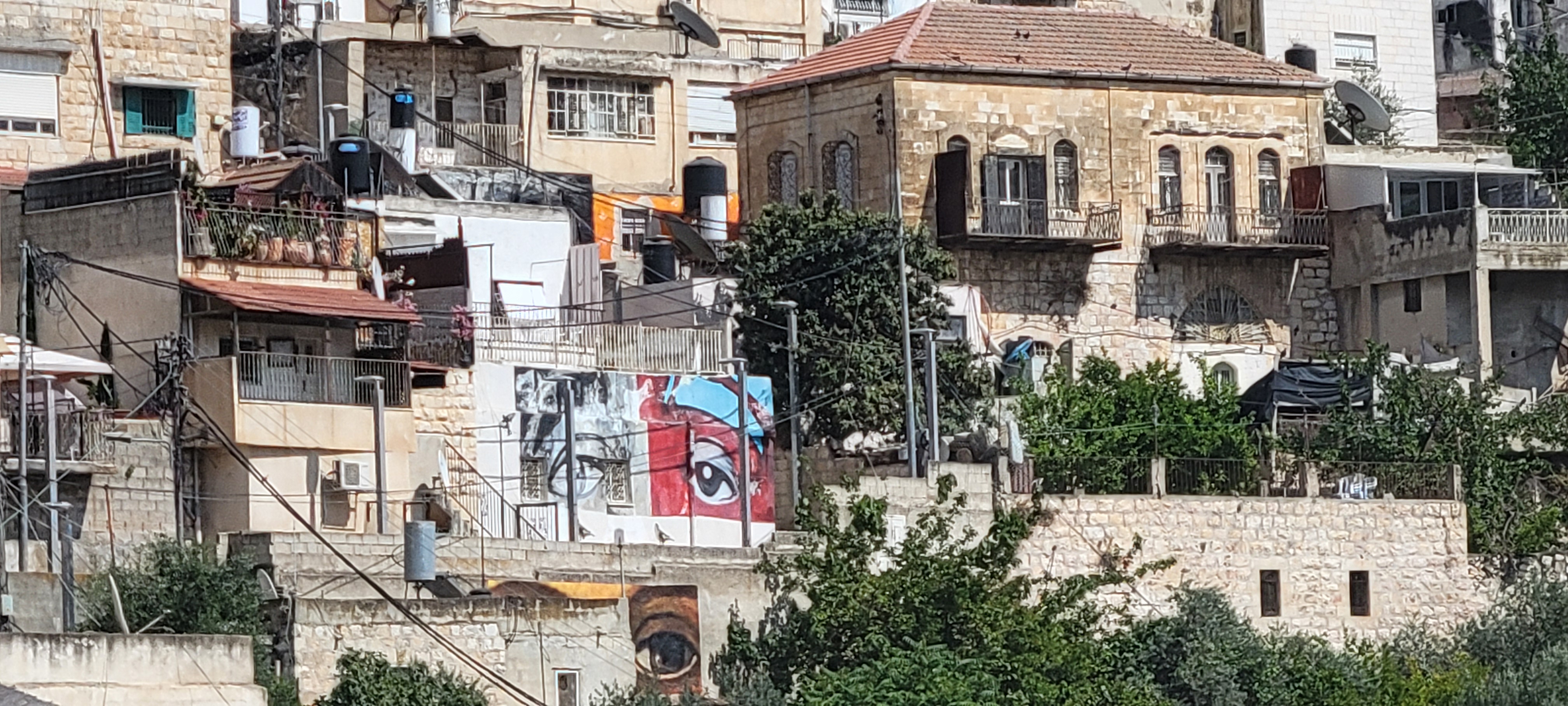
On our second day in Jerusalem, our delegation of mostly seminary professors visited Silwan, an Israeli-occupied East Jerusalem neighborhood that is also the site of a neighborhood-wide art installation, “I Witness Silwan.” It is an international collaboration of artists, activists, neighborhood residents, and others comprised mostly of murals depicting eyes wide open to bear witness to the ugly reality of Israeli occupation about which many people have turned a blind eye.
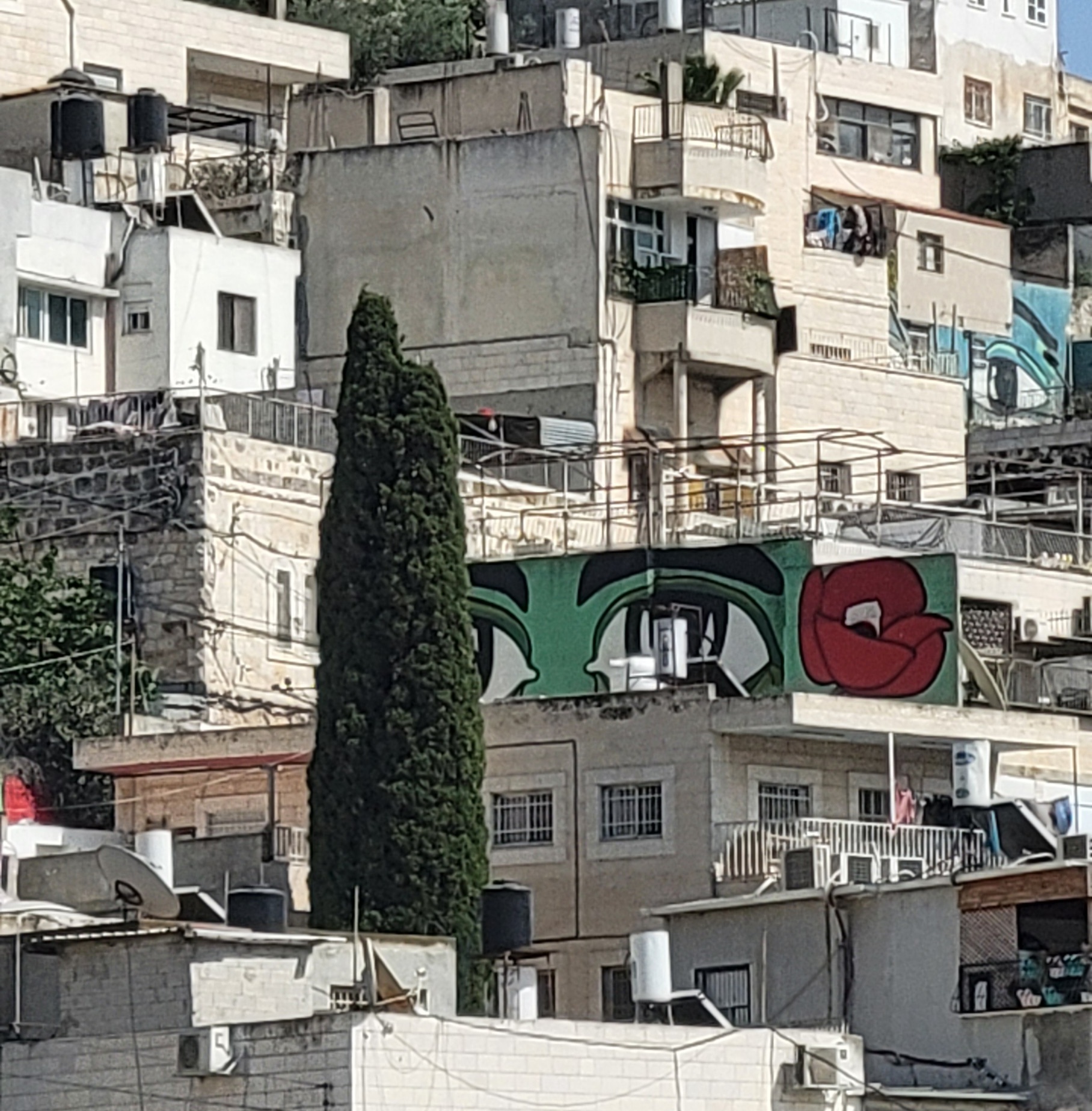
Jawad Siyam, director of the Madaa Creative Center in the neighborhood, expressed the art installation’s purpose simply. “The staring eyes say to people we see them and they should see us too… we want to say that we are here, we love our land and our home.”[1]
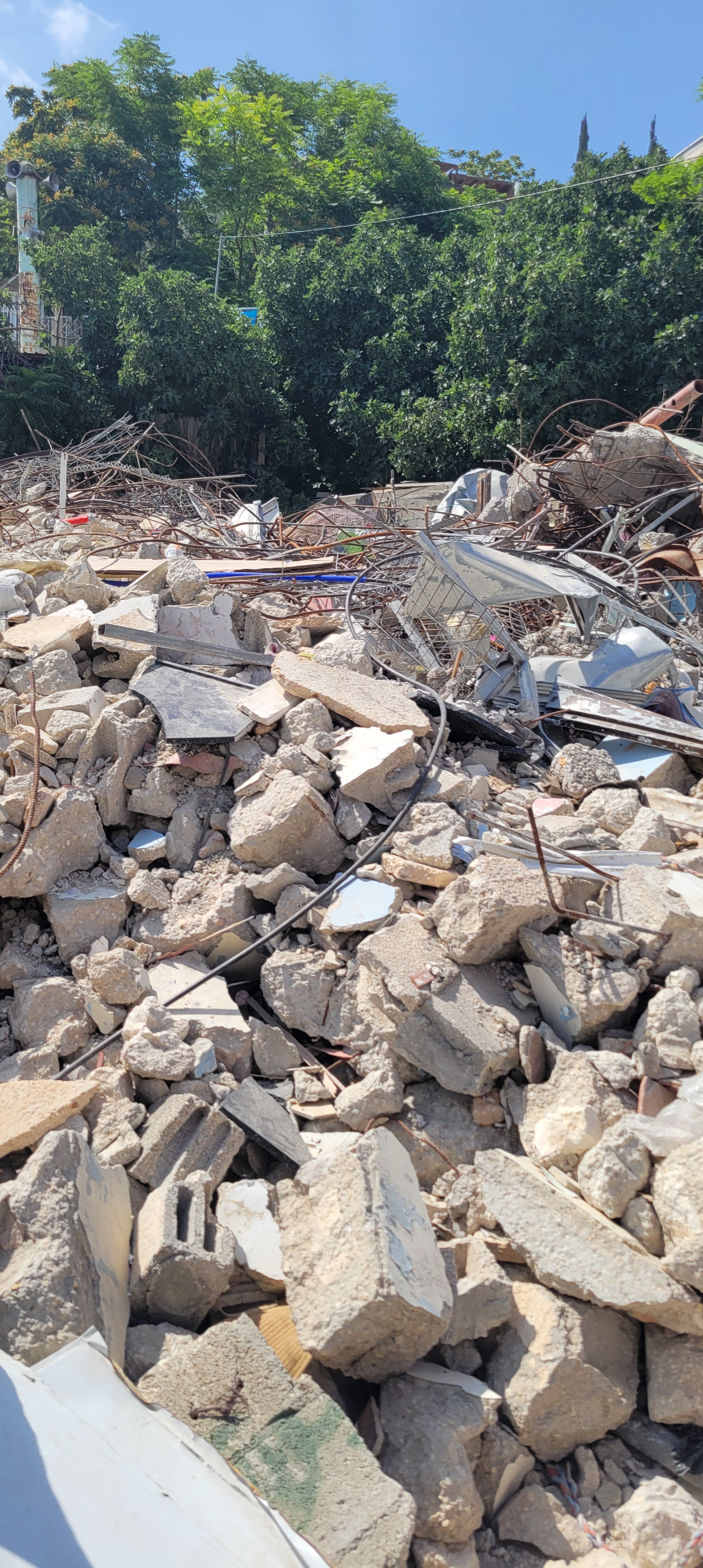
In this neighborhood, for many years now, the Israeli military has been in the process of bulldozing the homes of Palestinians who live there and installing surveillance cameras that invade the privacy of those who remain. We walked through the muraled streets of Silwan and saw the rubble from the many bulldozed homes. We were also told that one day after our visit, yet another home was illegally destroyed. Bulldozed homes became a common site throughout our time in the West Bank.
What is happening in the Silwan neighborhood also resonates powerfully with a story from the Bible that happened there, the healing of the man born blind (John 9: 1-41). Making mud from his own spit, Jesus put the mud on the blind man’s eyes and told him to wash in the pool of Siloam, an alternate spelling of Silwan. That pool still exists in the neighborhood behind an eight-foot-high steel fence with guards at the entrance.
As I reflect on this story of Jesus’ healing of the blind man, it becomes a kind of parable for my own blindness and the gradual conversion process this Sabeel delegation trip has prompted for me. The point of the story in John 9, it seems to me, is not really about the healing itself but rather the gradual conversion of the blind man (he is never named in the story but church tradition has called him Celidonius.) Only gradually does he realize who this Jesus fellow is and only gradually does his anger grow toward the religious officials who are so adamantly blind to all that the seeing man sees. At first, it seems the man is delighted that he can see but has little interest in the identity of the man who healed him. The now-seeing man would prefer, it seems, to move on. His neighbors, parents, and religious officials keep interrogating him, which leads him to fight back against the religious officials and to get a little cheeky. “Do you also want to become his disciples?”
A motto one frequently hears with Sabeel is “Come and See; Go and Tell.” In thinking about the story of the blind man, however, I am reminded that to move from blindness to really seeing is a gradual process for some of us. I have been willfully blind to the truth of what is happening today in Silwan (and throughout Palestine). I have known about what is happening there, of course, but like the blind man in the first moments after his healing, I have been content to acknowledge that this is just “not my issue.” I am busy enough, after all, writing, teaching my seminary classes, counseling students, and so on. By saying “yes” to going on this Sabeel delegation, however, I cannot “unsee” what I have seen. Like the blind man, more seems to be required of me.
I have seen the ugly concrete walls of division – literal and figurative – throughout the West Bank. I have seen the oppression of Palestinian farmers who cannot access their land. I have seen the consequences of innumerable Israeli laws that, in effect, tell Palestinians they are unwelcome in their own land; the 2018 Nation-State Law is only the most dramatic. I have seen the tears, and I have heard the testimony of a Palestinian person’s torture by members of the Israeli military. A picture I have of that person smiling and laughing in spite of it all is a powerful witness of resilience and has become an image in my prayers for the Palestinian people. With this blog, in my teaching, in my letters to elected representatives, I will “go and tell.” I have no illusions as to my own significance in doing any of this. The witness of those activists and peacemakers whose staring eyes are depicted in Silwan is far more powerful than my own.
We don’t know what happened with the blind man who had been healed in the years after his run-in with Jesus. Church tradition says he became a missionary in France. The word “Silwan” means “sent,” after all. I like to think he led a quiet life of faithful witness and still occasionally (or frequently) got a little cheeky with people who remained willfully blind. May God give me the grace to do likewise with eyes opening ever wider.
[1] Jawad Siyam cited in Susan Greene, “I Witness Silwan: Who is Watching Whom?” https://www.palestine-studies.org/en/node/1650290

 Mission and Methodism