In June of 2025 I participated in a delegation with the Sabeel Ecumenical Liberation Theology Center, a Palestinian Christian organization. We were mostly theological educators from five countries. It was my first time in the Occupied Palestinian Territories. Below are some of my reflections on this experience.
On my first morning in Jerusalem, I got up at dawn to walk the labyrinthine streets of the Old City, a few blocks from our hotel. I expected to get lost, and I did. But not for long. I soon found myself walking along the Via Delarosa with a growing number of early-morning commuters heading toward bus stops outside the Old City’s gates. Along the Via Delarosa, while still a tad lost, I stopped at a children’s playground to marvel at the merger of the contemporary with the ancient streets and buildings. I sat next to a plastic slide on a rubberized surface. It reminded me of the many playgrounds I visited with my children along Boston’s streets many years earlier.
Joining me in this little park was a group of six Israeli soldiers – roughly the same age as my now-adult children. The soldiers were talking and laughing together in Hebrew as they shared a Jerusalem bagel. Machine guns dangled from their shoulders, gently bouncing as they laughed. It was the first of many discordant images I encountered in Palestine as part of a Sabeel Ecumenical Liberation Theology Center delegation in June of 2025. I focused that morning on these soldiers’ humanity as they shared a simple breakfast in a park. I prayed for them and do so again as I write this.
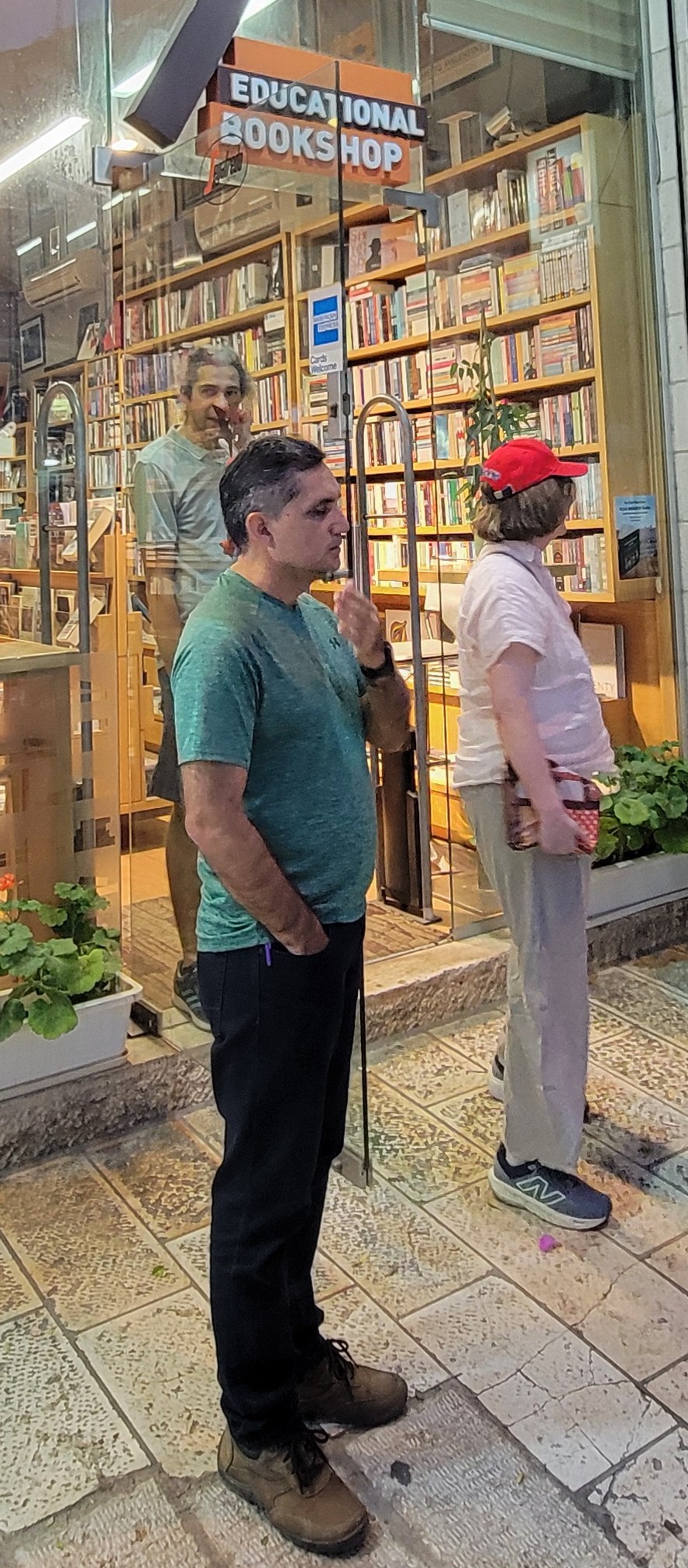
The evening before my morning walk, I had heard about a much different encounter with Israeli soldiers. It was the first of many testimonies by Palestinians I would hear that week of oppression and military control by the Israeli state. Ahmad Muna, whose Palestinian family owns the Educational Bookshop in East Jerusalem, spoke of his experience minding his shop while soldiers searched for material they could use as evidence of “inciting violence.” They interrogated Ahmad about Arabic-language books they could not read as they carelessly threw books on the floor. It was a frightening experience for Ahmad as he recounted how soldiers treated him and the literature he loved that told the story of the Palestinian people and the land that he loved even more.
These two experiences of discordant images—humanity, love for land and people, dehumanization, and military control—would be repeated multiple times during my ten-days’ participation with a Sabeel delegation of fourteen theological educators – mostly seminary professors like me from Peru, Guatemala, Canada, the UK, and the US. I have come away, predictably, with more questions than answers, but one thing is increasingly clear to me – namely, continued Zionist ideology, by Jews as well as Christians, that refuses to recognize Palestinians’ rightful place in their homeland alongside Jewish presence in their homeland is hurting everyone who lives there. This insight is nothing new. Prophets of nonviolent protest have long observed that the oppression of the oppressors dehumanizes them as much as the abuse dehumanizes victims.
I am not in any way arguing for an equivalency of suffering of Palestinians and Jews in the land they both call home. The deaths of tens of thousands of Palestinians in Gaza is a horrific atrocity taking place a mere 90-minute drive from where we were in the West Bank. What is happening in the West Bank is also horrific. I have no interest in the legalistic debate about whether to use the word “genocide” to describe what is happening. The director of Sabeel, Omar Haramy, was right; “We have no words for what is going on there.”
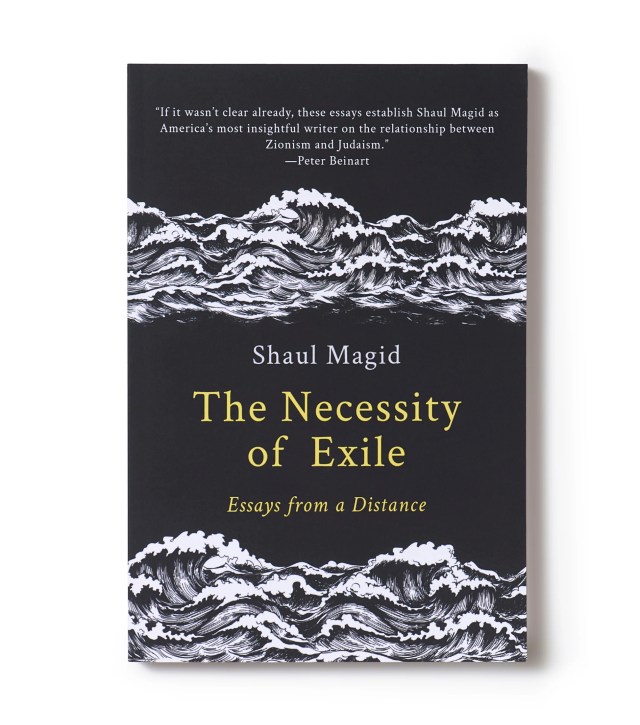
I am writing two weeks after returning to the US from Palestine. I have mostly been thinking about my experience in relationship to a book I am currently reading by Jewish rabbi and Dartmouth professor Shaul Magid, The Necessity of Exile: Essays from a Distance (Ayin Press, 2023). It was a book recommended to me by Fr. David Neuhaus, a Jesuit priest who works at the Pontifical Biblical Institute in Jerusalem. Our delegation met with him for just two hours on the same day as my morning meditation on the playground. Fr. Neuhaus is ethnically Jewish; his family lived in Germany for generations until they fled to South Africa shortly after Hitler rose to power. He grew up in apartheid South Africa, and when he moved to Jerusalem as a young adult the similarities disturbed him. I asked him a question at the end of our time together. I don’t remember my question, but I was thinking about those Israeli soldiers I had seen on the playground when I asked it. I wanted to know what he saw as a way forward.
What I received from Fr. Neuhaus was an enthusiastic endorsement of The Necessity of Exile by Shaul Magid.The author writes as a “counter Zionist” who sees no future in the Zionist cause as it has become increasingly ethnonationalist in nature. He acknowledges that Zionism might have been important eighty years ago, and he remains a supporter of the continued existence of the state of Israel. He argues that the Israeli state must be radically reformed as a democratic state with equal rights for all its citizens. Israel today is further away from that reality than at any point in its history. But as Fr. Neuhaus reminded us, it was hard to see a way forward in apartheid South Africa or East Germany in 1988 too.
As I read Magid’s book, I am struck by the fact that it is not really a political book but a theological one. Magid believes Judaism needs to rediscover its theological center as an exilic people – not as a negative identity marker but rather one to fully embrace. It is not a new idea in Judaism. Zionism, Magid explains, is a nationalist ideology that can be rejected today just as all but the most ardent white nationalist in the United States would reject the nineteenth century nationalist ideology of Manifest Destiny. From what I have learned from indigenous friends in the US, however, there is far more romantic attachment to the vestiges of Manifest Destiny than Magid or most white Americans would like to admit.
As a Christian, an exilic identity is a theological idea that resonates with my own faith’s reminder that we are pilgrims in a strange land. In my teaching, I routinely speak about the tremendous linguistic and cultural diversity of Christian expressions around the world. No single linguistic or cultural expression of Christianity is more important than any other. Christianity is, in a sense, continually “coming after” another culture and contextualizing itself in that culture but must never become equated with that culture. Unfortunately, Christian history is filled with examples of people doing precisely that, whether it be demanding linguistic conformity in the Latin language in the medieval period or the Christian nationalism of too many contemporary US evangelicals. This idea of the Jewish people as an exilic people is one I want to learn more about – from Shaul Magid and others – and I look forward to conversations about this in the months and years ahead. Re-imagining the “necessity of exile,” it seems to me is a big part of the theological work that needs to happen for there to be a future where Jewish, Palestinian, and other children live in peace and play on that Via Delarosa playground and share bagels without machine guns dangling from soldiers’ arms. That is an image I am praying with today. I invite you to do likewise and to influence others in your circle to promote justice in our world.

 Mission and Methodism
Thankyou for sharing this heart felt message. So many of the tragedies of war are evident in history as well as today. As you shared ” walk away with more questions than answers.” Difficult experience
Sent from AT&T Yahoo Mail on Android